The Secret to Building a Life That Stands the Test of Time: How Can I Strengthen My Family?
6 min read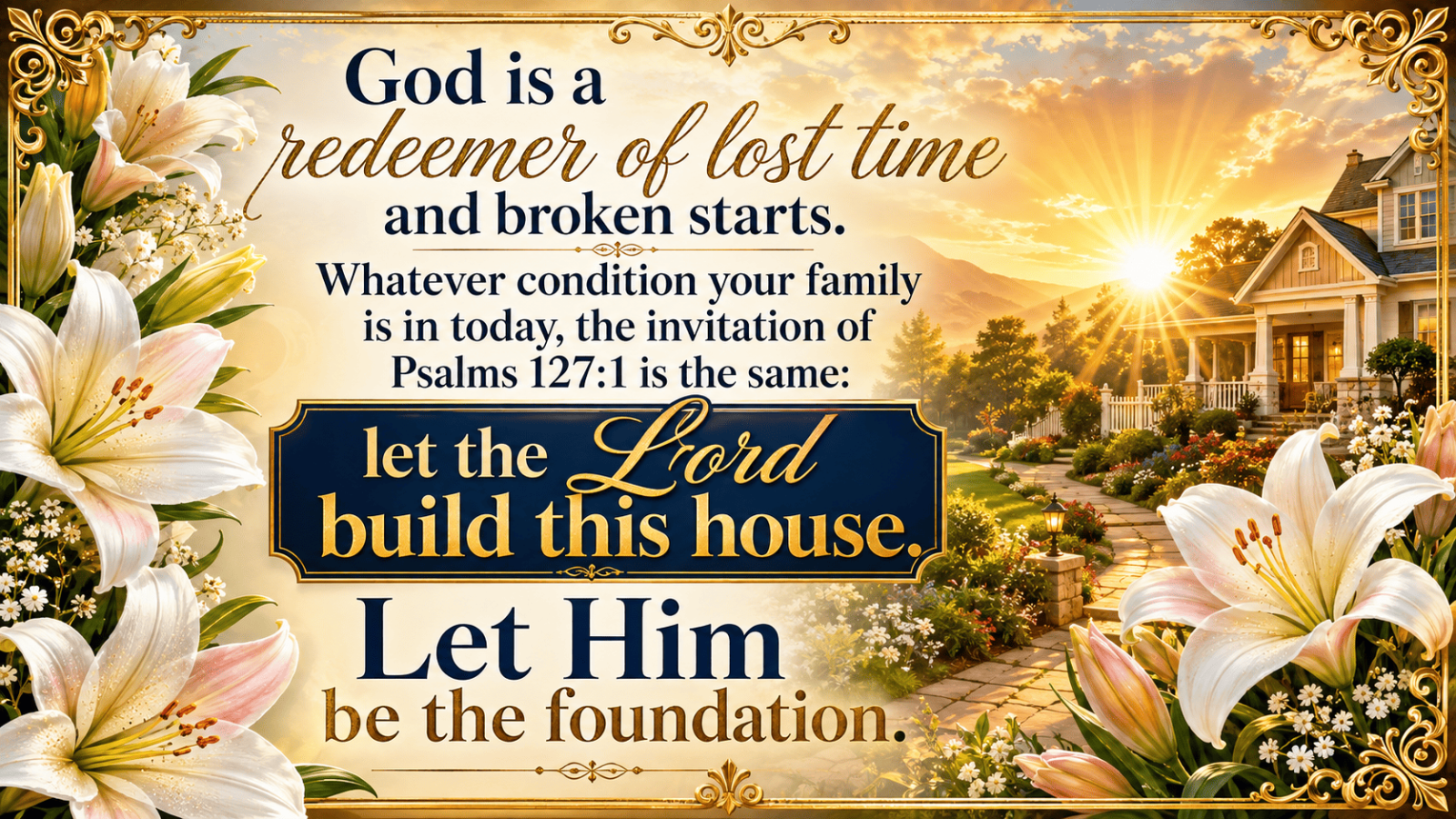
To strengthen your family, begin by inviting God into the center of your home through daily prayer, honest conversation, and intentional time together. Scripture teaches that lasting family strength is built on God’s foundation, not human effort alone. Start small, stay consistent, and lean on His grace when you fall short.
Start With the Foundation, Not the Symptoms
Most of us try to fix family problems the same way we fix a leaking pipe — we patch the visible crack. We buy the book, schedule the family meeting, make the new rule. Those things are not wrong, but they treat symptoms. Psalms 127:1 points us to the foundation first.
Inviting God into your family does not require a formal ceremony or a perfect track record. It begins with a simple, honest acknowledgment: Lord, I cannot hold this together on my own. That is not defeat. That is wisdom.
Consider setting aside even five minutes each morning — before the noise begins — to ask God to guide your words and actions toward your family that day. Small, consistent openings are how a foundation gets laid, one prayer at a time.
Your Words Are Building Materials
Proverbs 18:21 speaks to the life-and-death power of the tongue. Your words inside your home are among the most powerful forces shaping your family’s culture. Encouragement builds. Contempt erodes. This is not about being cheerful all the time — it is about being intentional.
Try this for one week: before you correct a family member, find one genuine thing to affirm about them first. This is not manipulation. It is the rhythm of grace — truth spoken inside a relationship where the person knows they are valued.
When you get it wrong — and every parent and spouse does — own it quickly. An apology spoken without qualification (‘I was wrong, I am sorry’) teaches your children more about grace and accountability than a hundred lectures ever could.
Presence Is the Gift That Cannot Be Purchased
Deuteronomy 6:6-7 describes faith being passed to children during the ordinary moments of daily life — walking, sitting, rising. The sacred is transferred in the routine, not only in the special.
You do not need a perfectly planned family night. You need to show up consistently in the small moments. Dinner at the table without phones. A bedtime conversation that goes a few minutes longer than you planned. A Saturday morning where you let a child choose the activity.
If distance or work or divorce means you cannot be physically present as much as you wish, presence can also be a phone call, a handwritten note, or a text that says: ‘I was thinking about you today.’ Consistency over time is what children and spouses remember.
Conflict Does Not Mean Your Family Is Broken
Every family has conflict. The question is not how to eliminate it but how to handle it in a way that leaves people more connected, not less. Ephesians 4:26 gives a striking instruction about not letting the sun go down on anger — not because pretending everything is fine is healthy, but because unresolved tension calcifies into walls.
Pursue repair quickly. A rupture in a relationship does not heal by itself. Someone has to take the first step, and often in a healthy family, the person who takes it is the one who is more mature in that moment — not necessarily the one who was ‘right.’
If conflict in your home has become chronic, entrenched, or involves any form of abuse, please do not face that alone. Seek pastoral counsel and, where needed, a licensed therapist or counselor. Prayer and professional help are not opposites — they work together, and asking for help is an act of courage, not weakness.
Pray Together, Even Imperfectly
Matthew 18:20 carries a beautiful promise about even two or three gathering in Christ’s name. Your family does not need to pray like a seminary professor. Short, honest, conversational prayer — spoken aloud together — changes the atmosphere of a home over time.
If praying aloud feels strange at first, start with a meal prayer. Then try adding a single sentence of thanks at bedtime with your children. Let them hear you be honest with God about hard things. Let them see that you need Him too.
Shared prayer also softens the ground for hard conversations. It is difficult to stay furious at someone you have just prayed alongside. This is not magic — it is the consistent, gentle work of the Holy Spirit among people who keep returning to God together.
Strengthen Yourself So You Can Strengthen Others
You cannot give what you do not have. This is not a self-help cliché — it is a spiritual reality. Galatians 6:9 warns against growing weary in doing good. Weariness is real, and a depleted person leads a depleted family.
Make sure you are connected to a community of faith — a church, a small group, a circle of friends who pray. Parents and spouses who are spiritually and emotionally nourished pour from a full cup. Those who never rest, never ask for help, and never receive care eventually have nothing left to give.
Rest is not laziness. It is stewardship of the person God made you to be. Psalm 23 does not skip the part about lying down in green pastures — that is God’s provision too.
A Long-Term Vision: What Are You Building?
Psalms 127:1 speaks of building a house. That image is worth sitting with. A house is not built in a day, and neither is a strong family. You are laying something that will outlast this season — habits, memories, patterns of grace that your children may one day pass to their own families.
Write down, even in a single sentence, what you want your family to look like in ten years. Not perfectly — just directionally. Then ask God regularly to align your daily choices with that vision. Small decisions, made faithfully over years, become the walls and roof of the home you are building.
You are not too late. God is a redeemer of lost time and broken starts. Whatever condition your family is in today, the invitation of Psalms 127:1 is the same: let the Lord build this house. Let Him be the foundation. The rest, He will help you figure out one faithful day at a time.
Lord, I admit I have been trying to hold this family together in my own strength. I am tired and I need You. Come be the foundation of our home — the thing we are actually built on.
Father, help me see my family members the way You see them. Where I have been impatient or distant, bring repair. Give me words that build rather than words that wound.
God, I bring before You the specific tension in my family right now. I do not know how to fix it. I ask You to move in ways I cannot. Bring healing where I have only been able to see the damage.
Lord, teach me to pray with my family — even when it feels awkward, even when the words are simple. Let our prayers together become the thread that ties us to You and to each other.
Frequently Asked Questions
What does the Bible say about building a strong family?
Scripture consistently connects family strength to God’s presence at the center of the home — Psalms 127:1 is the clearest statement of this. Other passages like Deuteronomy 6:6-7 and Ephesians 5-6 give practical shape to what that looks like day-to-day: passing faith through ordinary moments, honoring one another, and handling conflict with grace.
How do I bring faith into my family if not everyone believes?
You cannot force belief, but you can model it consistently and invite rather than pressure. Living out your faith with patience, kindness, and honesty is often more persuasive than any argument. 1 Peter 3:1-2 speaks to the quiet, enduring witness of a life changed by grace. Keep praying, keep loving, and trust God with the hearts you cannot reach.
What if my family is going through a crisis — divorce, illness, or loss?
God’s presence with your family does not depend on your family being intact or healthy. Psalms 34:18 tells us He is close to the brokenhearted. In seasons of crisis, the goal is not to fix everything at once but to take one faithful step, reach for one honest conversation, and ask for help — from God, from community, and from professional counselors when needed.
How do I strengthen my marriage as the core of my family?
A strong marriage is one of the greatest gifts you can give your children, and it is built through daily, unglamorous choices — choosing kindness when you are frustrated, pursuing connection when you are busy, and praying for your spouse by name. Ecclesiastes 4:12 describes a cord of three strands: two people and God together are far stronger than either alone.
Can one person strengthen a family, or does everyone have to participate?
One person who is genuinely changed by God’s grace can shift the culture of an entire household over time. You cannot control others’ choices, but you can control your own consistency — your patience, your presence, your prayers. Often a family’s transformation begins with one member who quietly refuses to give up and keeps showing up with grace.
Continue Reading

How Do I Trust God With My Finances? A Biblical Guide for Real Life
Trusting God with finances is a daily practice, not a formula. Learn biblical steps, honest prayer, and practical wisdom for seeking His kingdom first…

What Does the Bible Say About Giving? A Plain-Language Guide for Every Stage of Faith
Wondering what the Bible says about giving? This plain-language guide explores scripture about giving, tithing, generosity, and how to build a giving…
What Jesus Meant by ‘I Am the Way, the Truth, and the Life’
What did Jesus mean by 'I am the way the truth and the life'? A plain, pastoral explanation of John 14:6 for seekers and new believers.