The Daily Habit That Can Transform Your Family Forever: How Do I Teach Children About Jesus?
6 min read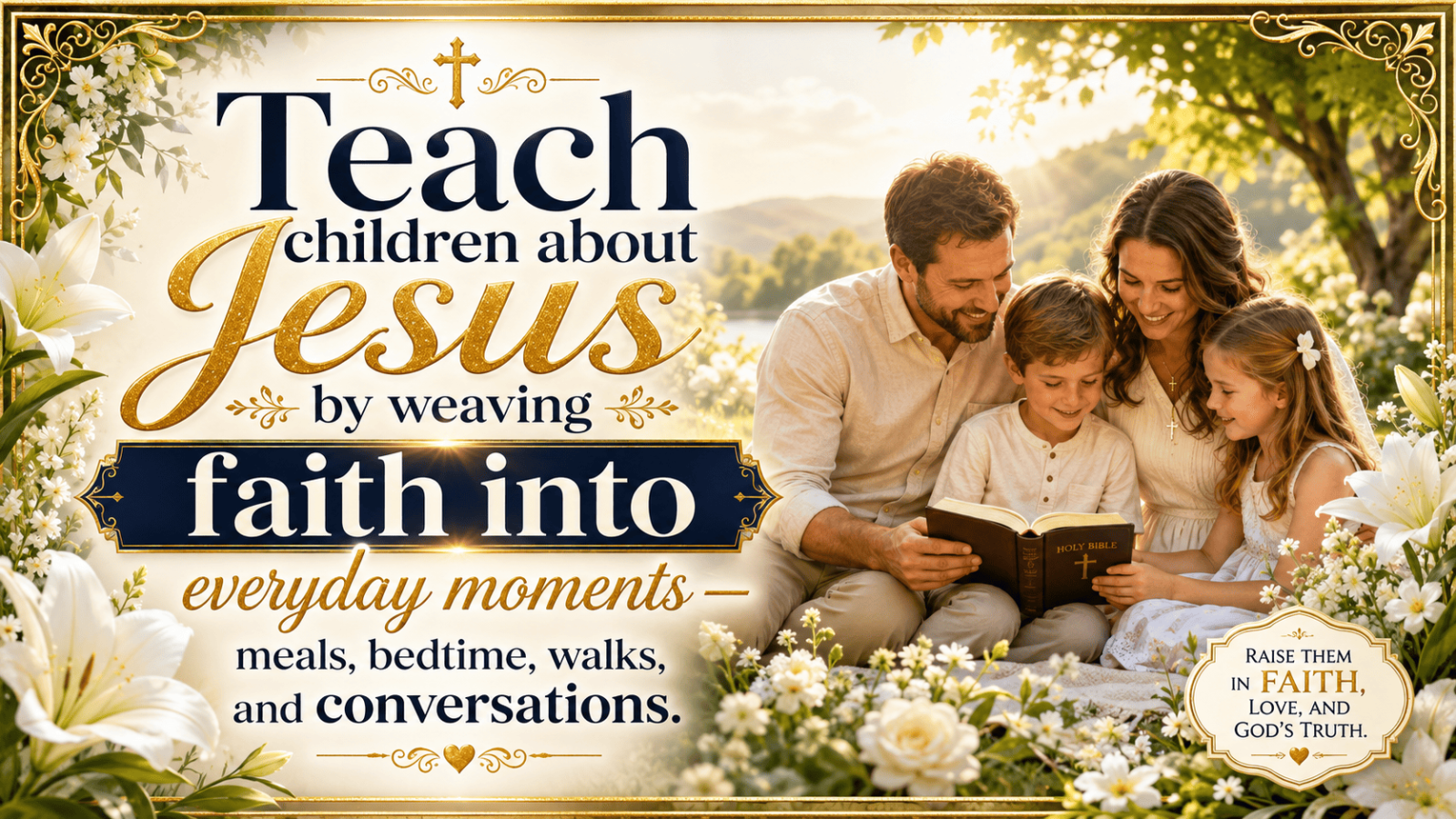
Teach children about Jesus by weaving faith into everyday moments — meals, bedtime, walks, and conversations. Read Bible stories together, pray out loud so they hear you talk to God, answer their questions honestly, and let them see your own trust in Jesus lived out naturally at home.
Start With Who Jesus Is — Not Just What He Did
Children can memorize facts about Jesus — he was born in Bethlehem, he fed five thousand people, he rose from the dead — without ever feeling like he is a real person who knows their name. Start there: Jesus is a person, not a concept.
Tell children that Jesus laughed at parties (John 2:1-11), that he wept at a friend’s grave (John 11:35), that he let children climb on him when the adults tried to shoo them away (Mark 10:13-16). These details matter. A child who pictures Jesus as warm and approachable will pray to him more naturally than one who only knows him as a distant, holy figure.
You do not need a theology degree for this conversation. You just need to open a Gospel — Matthew, Mark, Luke, or John — and read it out loud together. Let the story do most of the work.
Make Prayer a Real Conversation, Not a Performance
One of the most powerful things you can do is let children hear you pray in plain, honest language. Not a polished speech — a real conversation. “Lord, I am worried about this. Thank you for that beautiful thing that happened today. Help us be kind to each other this week.”
When children hear adults pray authentically, they learn that prayer is not a ritual reserved for experts. It is talking to someone who is listening. Invite them to add their own words. Even a three-year-old can say, “Thank you, God, for my dog.” That is real prayer.
Pray at natural transition points: before meals, before sleep, when something scary happens, when something wonderful happens. These small moments build a habit that can carry a child through their entire life.
Use Stories — the Bible Is Full of Them
Children are wired for narrative. Before they can understand doctrine, they can understand a story about a boy with five loaves of bread and two fish, or a lost sheep that someone went looking for, or a father who ran down the road to meet his returning son.
A good children’s Bible is worth every penny. Look for one that stays faithful to the actual text rather than softening every story into something unrecognizable. Children can handle honesty; they handle it better than you might expect.
As children grow older, move from children’s Bibles toward reading the actual Gospels together. Pause and ask questions: “Why do you think Jesus said that? How do you think the disciples felt? What would you have done?” Curiosity is not a threat to faith — it is how faith grows.
Answer Hard Questions Without Pretending You Know Everything
Children will ask questions that have stumped theologians for centuries. Why did Jesus have to die? Why does God let bad things happen? Is Grandma in heaven? You are allowed to say, “That is a really good question, and I am not completely sure. Here is what I do believe…”
Honesty about uncertainty actually builds trust. A child who grows up hearing “I don’t know everything, but I trust God” is better prepared for adult faith than one who was given tidy answers that fell apart under pressure.
When grief or illness or loss enters the conversation, treat those topics gently. Never suggest that suffering is punishment for weak faith. Acknowledge that hard things are hard, that Jesus himself wept (John 11:35), and that God is present even in pain. If a child — or you — is carrying something heavy, prayer and professional support belong together. Reaching out to a counselor is not a sign of weak faith; it is wisdom.
Live It Where They Can See You
Children absorb more from watching adults than from any lesson you could plan. When they see you choose forgiveness over resentment, serve someone in need without making it a big announcement, or sit quietly with your Bible in the morning — those images stick.
This does not mean performing a perfect Christian life for an audience. It means letting them see the real thing: including the moments when you admit you were wrong, when you say “I need to pray about this,” or when you choose patience even though it costs you something.
You do not have to be a perfect example. You have to be a real one. Grace covers the rest — and watching you receive grace teaches children that they can receive it too.
Build Rhythms, Not Just Events
A single trip to a Christmas service or Easter event is a gift, but it is not the same as a rhythm. Rhythms are the repeated, ordinary practices that shape a child’s sense of what is normal and true.
Consider what rhythms you can build right now — not grand ones, just consistent ones. A few minutes of Bible reading after dinner. A prayer before the school day begins. A song during bath time for small children. A weekly practice of asking, “What are you grateful for this week?”
Small and steady wins over occasional and spectacular. Faith is more like a garden than a fireworks display. It needs regular tending, not just one brilliant show.
Bring Your Church Community Into the Picture
You were not meant to do this alone. The church — imperfect as every local congregation is — exists partly so that children can be surrounded by multiple adults who love Jesus. A Sunday school teacher, a youth leader, a grandparent in the pew: each one adds a voice to what you are already building at home.
If you do not yet have a church community, or if you are still figuring out what you believe yourself, that is all right. Start where you are. God meets seekers on the road, not only at the destination. Many churches welcome people who are exploring, not just those who have arrived.
And if you are new to faith yourself — if you are teaching children about Jesus while still learning about him — that is one of the most honest things you can do. Learning alongside a child is not weakness. It is an invitation for both of you to grow.
Take a moment right now and pray simply: “Lord, I want the children in my life to know you. Show me how to do this well, in the ordinary moments of our days together.”
Think of one child by name. Pray for them specifically: “God, you know everything about them — their fears, their questions, their future. Draw them close to you. Use me however you want to, and fill in what I lack.”
Pray honestly about your own uncertainties: “I don’t always know what to say or how to explain things. Give me wisdom, and help me trust that you are at work even in my imperfect efforts.”
Close with gratitude: “Thank you that you love these children more than I do. Thank you that this is your work, and I am only invited to join it.”
Frequently Asked Questions
What age should I start teaching children about Jesus?
You can begin as early as infancy — not with formal lessons, but with prayer, song, and gentle stories. Babies and toddlers absorb the tone and rhythm of faith long before they understand words. There is no age too young to begin, and no age too old to start.
What if I don't know the Bible well enough to teach my child?
You do not need to be a Bible scholar to point a child toward Jesus. A good children’s Bible, a willingness to read together, and an honest “I’m still learning too” go a long way. Learning alongside your child is not a disadvantage — it models the kind of humble, ongoing faith you want them to have.
How do I answer my child's questions about God when I don't know the answers?
Say so honestly. “That’s a hard question, and I’m not sure I know the full answer” is a truthful and trustworthy response. Share what you do believe, acknowledge what remains a mystery, and let the question sit open without forcing a tidy resolution. Children respect honesty far more than false certainty.
Can I teach my child about Jesus even if I'm not a strong believer myself?
Yes. Many people begin teaching children about faith while they are still working out their own. Introducing a child to Jesus, reading Gospel stories together, and praying simple prayers are all things you can do as a seeker. Your honesty about your own journey can itself be a powerful lesson in what real faith looks like.
How do I talk to children about Jesus when something painful or scary has happened?
Start by acknowledging the pain rather than rushing past it. Let children know that Jesus himself experienced grief and loss, and that it is right to feel sad or scared. Pray together in simple, honest words, and resist the urge to offer explanations for suffering that scripture does not actually give. If a child — or you — is struggling significantly, involving a counselor or pastor alongside your prayers is a healthy and wise step.
Continue Reading

How Do I Trust God With My Finances? A Biblical Guide for Real Life
Trusting God with finances is a daily practice, not a formula. Learn biblical steps, honest prayer, and practical wisdom for seeking His kingdom first…

What Does the Bible Say About Giving? A Plain-Language Guide for Every Stage of Faith
Wondering what the Bible says about giving? This plain-language guide explores scripture about giving, tithing, generosity, and how to build a giving…
What Jesus Meant by ‘I Am the Way, the Truth, and the Life’
What did Jesus mean by 'I am the way the truth and the life'? A plain, pastoral explanation of John 14:6 for seekers and new believers.