How Do I Stay Faithful to God? A Practical Guide for Seekers and New Believers
6 min read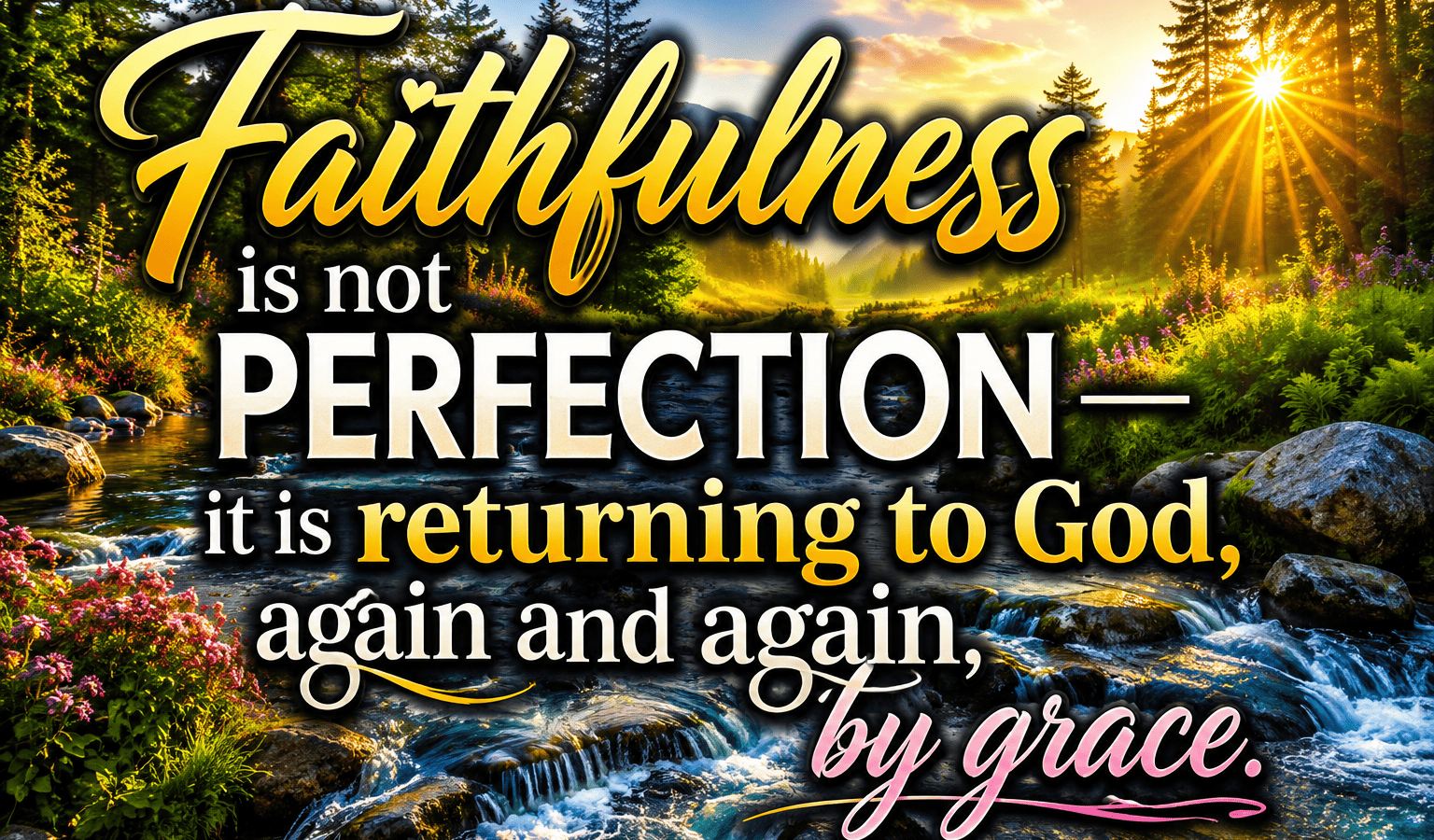
Staying faithful to God means returning to Him daily through prayer, Scripture, honest community, and obedience — even when it is hard. Faithfulness is not a feeling; it is a repeated choice. God promises in Revelation 2:10 that those who remain faithful, even through suffering, will receive the crown of life.
What Does Being Faithful to God Actually Mean?
Faithfulness is not the same as spiritual perfection. It does not mean you never doubt, never sin, or never feel distant from God. The biblical picture of faithfulness is closer to a marriage than a performance — steady presence, honest communication, and returning after distance.
Think of Lamentations 3:22-23, where the writer cries out from deep grief and still declares that God’s mercies are new every morning. That is faithfulness: showing up again, even after a hard night.
Faithfulness also does not require you to feel a certain way. Emotions come and go. What God asks for is your continued turning toward Him — your yes, renewed each day, sometimes each hour.
Start Small: The Daily Rhythms That Build Lasting Faith
Big spiritual breakthroughs are real, but they are not where faithfulness is built. Faithfulness is built in small, repeated acts: opening your Bible in the morning, saying a short honest prayer before work, pausing to thank God before a meal.
Jesus talked about this principle in Luke 16:10 — trustworthiness in small things precedes trustworthiness in large things. Your faith grows the same way a muscle does: consistent, modest use over time.
Pick one practice and anchor it to something you already do every day. Pray while your coffee brews. Read a single psalm before bed. These small anchors do more for long-term faithfulness than occasional bursts of religious intensity.
If you miss a day — or a week — you simply begin again. There is no spiritual penalty that prevents you from returning. The parable in Luke 15:11-32 makes this radically clear: the Father runs toward the one who comes back.
What to Do When Suffering Makes Faithfulness Feel Impossible
Revelation 2:10 does not promise that faithfulness will protect you from hard things. It promises something better: that God sees your suffering, that it is not the end of your story, and that a crown of life awaits those who hold on.
Suffering does not mean your faith is weak or that God is punishing you. Grief, illness, loss, and hardship are part of the human experience — and the Psalms (try Psalm 22 or Psalm 88) show us that raw, even anguished honesty with God is itself an act of faithfulness.
If you are carrying anxiety, depression, or grief right now, please know that seeking professional help — a counselor, a therapist, a doctor — is not a failure of faith. It is wisdom. Prayer and professional care belong together, not in competition.
In those seasons, faithfulness might look nothing like devotional joy. It might just look like whispering, God, I don’t understand this, but I am still here. That whisper counts.
You Need Other People: The Role of Community in Staying Faithful
You were not designed to follow God alone. Hebrews 10:24-25 is direct about this — believers are meant to stir one another toward love and good works, and to keep meeting together. Isolation is one of the most common reasons people quietly drift from faith.
A church community, a small group, a trusted believing friend — these are not optional extras. They are the hands and voice of God in your life. When you cannot feel God’s presence, another person’s faith can carry you for a season.
You do not need to find a perfect church. You need to find a community where the Bible is taken seriously, where grace is genuinely extended, and where people are honest about their struggles. Those communities exist. Keep looking until you find one.
When You Feel Like You Have Already Failed
Perhaps the real question underneath your question is this: Is it too late for me? Have I drifted too far, sinned too much, been too inconsistent for God to still want my faithfulness?
The answer Scripture gives again and again is no. Peter denied Jesus three times and became one of the pillars of the early church (John 21:15-19). Paul persecuted Christians before he became one (Acts 9). God’s track record with people who feel too far gone is remarkable.
Faithfulness after failure looks like 1 John 1:9 — honest confession, receiving forgiveness, and taking the next step forward. Not a dramatic moment necessarily. Just a turning. Just a beginning again.
You do not have to earn your way back. You simply return. The returning is itself the faithfulness God is asking for.
Practical Steps You Can Take This Week
Read one psalm each day. The Psalms were written by people who knew both mountaintop faith and crushing despair. They will meet you wherever you are.
Pray honestly, not impressively. You do not need formal language or long prayers. A one-sentence prayer spoken from your actual emotional state is heard. Try something like: God, I want to stay close to you. Help me today.
Tell one person where you are spiritually. Not a performance — just honesty. Vulnerability invites accountability, and accountability strengthens faithfulness more than almost anything else.
Memorize Revelation 2:10 or another short verse. Having Scripture in your memory means you carry it into moments when you have no Bible in hand — moments of temptation, fear, or doubt.
Serve someone this week. James 2:17 connects faith and action. Often the fastest way to reignite a cooling faith is to get your hands involved in something God cares about — feeding someone, encouraging someone, helping someone.
A Promise Worth Holding Onto
The phrase in Revelation 2:10 — the crown of life — was a metaphor that first-century readers understood immediately. A victor’s crown. Not something earned by earning, but something given by a generous King to those who stayed in the race.
God is not grading your spiritual performance on a curve and waiting for you to fail. He is the one cheering you forward, as Hebrews 12:1-2 describes — with a great cloud of witnesses around you and Jesus himself as the author and finisher of your faith.
You are not expected to generate faithfulness out of your own willpower. You are invited to receive grace, draw on it daily, and let it shape a life that looks — slowly, imperfectly, beautifully — more and more like the person God made you to be.
Sit quietly for a moment. Tell God exactly where you are right now — not where you think you should be, but where you actually are. He already knows, and He is not surprised.
Ask God to show you one small act of faithfulness you can offer Him today. Not a grand gesture — just one step. Then ask for the grace to take it.
If you are suffering right now, bring that suffering into your prayer without dressing it up. Tell God it is hard. Ask Him to be present in it with you, and to give you what you need to hold on.
Close by receiving, not just asking. Rest a moment in the promise of Revelation 2:10 — that the same God who calls you to faithfulness is the one who will give you the crown of life. Thank Him that the outcome of your faith rests ultimately in His hands, not yours.
Frequently Asked Questions
What if I keep failing and feel like I can never stay faithful?
Repeated failure does not disqualify you from faithfulness — it is actually the normal Christian experience described honestly throughout Scripture. Faithfulness is not an unbroken streak; it is the pattern of returning. Each return, no matter how many times you have wandered, is itself an act of faithfulness God honors.
How do I stay faithful to God when I am going through a really hard time?
In seasons of genuine suffering, faithfulness often shrinks down to its most essential form: continuing to speak to God even when you cannot sense His presence. The Psalms show that lament and honesty with God are valid expressions of faith, not signs of weakness. If you are struggling with mental health or grief, seeking professional support alongside prayer is wise and completely consistent with trust in God.
Does being faithful to God mean I have to go to church?
Regular gathered worship is something Scripture consistently commends, and most believers find that community is essential for sustaining faith over the long term. That said, your first step might simply be finding one other believer to meet with honestly and regularly. From that small beginning, deeper community often grows.
How long does it take to build a faithful relationship with God?
A faithful relationship with God is built the same way any deep relationship is — through consistent, honest engagement over time, not through a single dramatic experience. Small daily practices compound over months and years into a durable faith. There is no fixed timeline; you begin wherever you are today.
Can I be faithful to God even if I still have a lot of doubts?
Yes. Doubt and faith are not opposites — doubt is often what faith works through rather than what it avoids. Many of the most admired figures in Scripture, including the Psalmists and the apostle Thomas, expressed deep uncertainty while continuing to turn toward God. Bringing your doubts honestly to God in prayer is itself a form of faithfulness.
Continue Reading

Nothing Compares to Knowing Jesus: What Can We Learn From Paul? Seven Lessons That Still Change Lives
Discover what can we learn from Paul — seven practical, biblical lessons from his life and letters for seekers and new believers starting their faith…
What Can We Learn From Joseph? Seven Lessons From a Life God Refused to Waste
What can we learn from Joseph? Seven biblical lessons on faith, integrity, forgiveness, and trusting God through betrayal and suffering. A devotional…
Jesus’ Powerful Warning About Heaven, Hell, and the Final Judgment: What Does the Bible Say About Hell?
What does Matthew 25:46 mean? Discover what Jesus teaches about eternal life, the final judgment, and why your response to Him matters for eternity.